Welcome to the Age of the Bullshit Agent
No video selected
Select a video type in the sidebar.
AI may finally kill the bullshit job. Unfortunately, it may also invent the bullshit agent
A few business books manage to be both genuinely enjoyable and genuinely useful. Three come to mind:
- Shoe Dog: A Memoir by the Creator of Nike - by Phil Knight
- Unreasonable Hospitality: The Remarkable Power of Giving People More Than They Expect (The Unreasonable Hospitality Collection) - by Will Guidara
- Bullshit Jobs: A Theory by David Graeber
I’ve just finished David Graeber’s Bullshit Jobs, and its central argument is provocative: a bullshit job isn’t simply bad, boring, or poorly paid. It is a job that the person doing it believes is fundamentally pointless, while being expected to maintain the fiction that it serves a meaningful purpose. I see this a lot.
There are hordes of people like HR consultants, communication coordinators, telemarketing researchers, corporate lawyers, whose jobs are useless, and, tragically, they know it. These people are caught in bullshit jobs
You can learn more about Graeber and his work here: davidgraeber.org.
It’s a totally bonkers paradox
Technology was supposed to make us dramatically more productive. Logically, that should have meant working fewer hours.
Instead, Graeber argues, organizations created vast amounts of administrative, managerial, and corporate work whose social value can be difficult to identify, even for the people doing it.
Because employment is tied to identity and status, we collectively maintain the fiction that all this activity must be important.
Graeber groups bullshit jobs into five memorable types:
- Flunkies: roles that primarily exist to make someone else appear important.
- Goons: roles that exist largely because competing organizations employ people in equivalent roles.
- Duct tapers: people who continually fix problems that arguably shouldn’t exist.
- Box tickers: people who produce evidence that something is being done rather than accomplishing the thing itself.
- Taskmasters: people who create or supervise unnecessary work.
What I find particularly interesting is what happens when Graeber’s world of bullshit jobs collides with AI. His underlying question was essentially:
If technology keeps making us more productive, why aren’t we working dramatically less?
That is different from a bad job. A cleaner, waiter, garbage collector, nurse, or construction worker may have a difficult job, but the value of the work is obvious.
A bullshit job is different. Remove it tomorrow, and remarkably little of value would change.
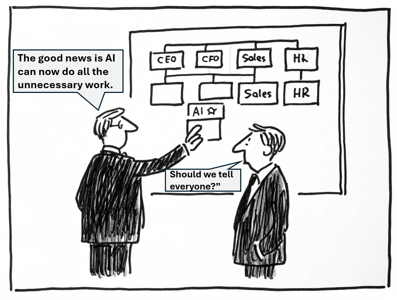
AI could destroy an enormous amount of what Graeber called bullshit work, without necessarily destroying the actual jobs.
People may be more willing to delegate pointless tasks to AI, especially when those tasks appear to require little human judgment or oversight. So AI might not eliminate bullshit work; rather, it might industrialize it.
AI can make organizations extraordinarily efficient at producing things that were never particularly necessary in the first place. AKA efficient inefficiency.
Is that the world we’re heading toward?
We don’t need 20 PowerPoints anymore.
AI can produce 2,000 PowerPoints.
We don’t need three status reports.
An agent can create one every hour.
Not every meeting needs minutes, a summary, five action-item emails, and a dashboard. But AI makes producing all of them virtually free.
And that is the danger: AI doesn’t eliminate bureaucracy. It gives bureaucracy a superpower.
We used to spend Tuesday afternoon producing a dashboard nobody opened. An AI agent can now produce it hourly, which is progress, in a way. Tick-the-box use case.
A pointless process performed by a human is merely wasteful; performed by AI, it becomes wasteful at scale and arrives in your inbox before breakfast. The clever move is not to make every process faster, but to notice which processes should disappear. Before you automate a task, ask whether it deserves to survive.
Other titles I considered for this post:
- Welcome to the Age of the Bullshit Agent
- Automated Bullshit Is Still Bullshit
- AI Is Making Useless Work More Efficient
- What If AI Makes the Wrong Things More Efficient?
- Before You Automate It, Ask Why You’re Doing It


